


Shirakawa Gokou Matcha
Seicha TsujikiRich, round, and deep, Kiyoharu Tsuji’s exquisite Gokou brings out the best from this highly acclaimed cultivar.
Producer: Tsujiki
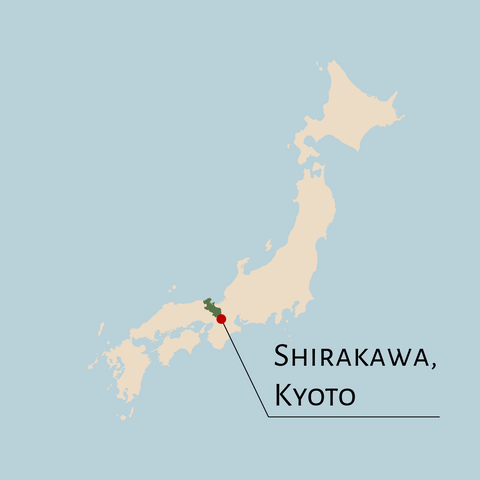
Region: Shirakawa, Kyoto
Cultivar: Gokou
Harvested: May, 2025
Picking: Hand-picked
Located a short drive south of Uji City, Shirakawa's tea fields are nestled among rolling hills. This area is lnown primarily for producing high-grade gyokuro. Though much smaller than the nearby Wazuka and Ujitawara regions, Shirakawa is a prime growing area for top-tier Ujicha.
Gokou was selected from an Uji zairai in the early 1950s. Despite its age, it is still an unregistered cultivar that is nonetheless popular in Kyoto for use in gyokuro and matcha production. Its leaves are relatively thin, making them ideal for shaded tea production and produce a yield comparable to Yabukita.
Gokou has a very strong character which means it is rarely sold unblended. Mellow in taste with a deep but not overpowering umami, Gokou's most distinct characteristic is its unique, fruity aroma, which stands out when sold as a single cultivar tea.
Brewing Instructions
 Usucha
Thin Tea
Usucha
Thin Tea
 Heat water to 70º C (158º F)
 Add 70 ml (2.4 oz) of water to 2 g (2 tea scoops) of sifted matcha
 Whisk briskly in a back and forth motion for about 20 seconds
 Koicha
Thick Tea
Heat water to 85º C (185º F)
Add 30 ml (1 oz) of water to 4 g (3-4 tea scoops) of sifted matcha
Knead the tea in a circular motion until smooth and glossy
Koicha
Thick Tea
Heat water to 85º C (185º F)
Add 30 ml (1 oz) of water to 4 g (3-4 tea scoops) of sifted matcha
Knead the tea in a circular motion until smooth and glossy
Seicha Tsujiki (製茶辻喜)
This tea producer needs no introduction. Headed by fifth generation tencha farmer, Tsuji Kiyoharu (辻喜代治) whose name is legendary in the tea world, they have won countless prestigious awards for their peerless matcha. Tsuji-san’s personal mission is to push the boundaries of matcha production by combining traditional techniques with cutting-edge techniques and his own creativity and ingenuity. In doing so, he has set records for the amount of amino acids (umami compounds) concentrated in his tea leaves, at percentages over double the usual amount. His teas have won first place recognition on the regional and national level multiple times, making him the most awarded tencha farmer in Japan.

Tsujiki’s extreme level of umami comes from an equally extreme approach to tencha production. Tsuji-san uses a top-secret self-crafted mix of high-grade organic fertiliser, which he applies to the plants at double the normal rate, stuffing the leaves full of nutrients and umami compounds. On top of this, he shades his plants at 95% darkness, 10% more than most farms, which further amplifies and concentrates the umami. Lastly, he picks his plants only once per year, entirely by hand, ensuring that the maximum amount of umami can be presented in the final tea.